Owning a rental property in New Zealand takes more than collecting rent every fortnight. Whether you own one investment property or manage a growing portfolio, you need to understand your landlord responsibilities under NZ law. Get this wrong, and you risk disputes, penalties, and unhappy tenants.
Many new landlords don’t realise how much legislation shapes the relationship between landlord and tenant. Healthy Homes Standards, bond handling, smoke alarms, noise complaints — the rules run deep, and the penalties for non-compliance can be steep.
This guide breaks down everything a New Zealand landlord needs to know. We’ll cover what’s expected before, during, and after a tenancy, how commercial landlord obligations differ, and what to do when a noise complaint lands on your desk. By the end, you’ll know exactly where you stand — and where you might want extra support.
Quick Summary Box
- Landlord responsibilities in NZ sit mainly under the Residential Tenancies Act 1986 and the Healthy Homes Standards
- Obligations apply before, during, and after a tenancy — not just when something breaks
- Non-compliance can trigger financial penalties and Tenancy Tribunal orders
- Commercial landlords face a different set of rules, shaped largely by the lease itself
- Many landlords choose professional property management to reduce risk and save time
Understanding Landlord Responsibilities in New Zealand
What Landlord Responsibility Means in NZ
Landlord responsibility NZ legislation balances two things: a tenant’s right to safe, healthy housing, and a landlord’s right to protect their property and income. The Residential Tenancies Act 1986 sits at the centre of this framework. It sets out the legal obligations both parties must follow for the life of a tenancy.
In practical terms, landlords must provide a property that’s safe, healthy, and fit to live in. They need to maintain it properly, respect the tenant’s right to privacy and quiet enjoyment, and manage rent, bond, and records correctly.
Why It Matters
These aren’t loose guidelines — they’re legal obligations, and the Tenancy Tribunal enforces them. The Healthy Homes Standards now apply to every private rental in the country. There’s no phase-in period left, and every property must meet the required standards for heating, insulation, ventilation, moisture control, and draught stopping.
Enforcement has tightened noticeably. A landlord who fails to meet Healthy Homes obligations breaches the Residential Tenancies Act and can face exemplary damages of up to $7,200 per breach. Skip the compliance statement in a tenancy agreement, and further penalties can follow. Managing every requirement without professional support has become a genuinely demanding job.
A Landlord’s Responsibilities Include NZ: Complete Checklist
Wondering exactly what a landlord’s responsibilities include in NZ? Use this checklist to cover the core legal obligations:
✓ Healthy Homes Standards — heating, insulation, ventilation, moisture and drainage, and draught stopping must all meet minimum legal thresholds
✓ Smoke alarms — working alarms must sit within three metres of every bedroom door
✓ Property maintenance — the property must stay in a reasonable state of repair throughout the tenancy
✓ Safe electrical systems — wiring, appliances, and fittings must be safe and compliant
✓ Plumbing — hot and cold water, drainage, and sanitary fixtures must work properly
✓ Structural repairs — the building’s structure, roof, and weathertightness need ongoing upkeep
✓ Secure locks — doors and windows need adequate locks for reasonable security
✓ Clean premises — the property must start the tenancy in a reasonably clean condition
✓ Rent records — landlords must keep accurate records and provide them to tenants on request
✓ Bond handling — bonds need correct lodging and return under the rules
✓ Privacy obligations — tenants have a right to quiet enjoyment; landlords must give proper notice before entering
✓ Insurance — not always mandatory, but appropriate landlord insurance protects responsible property owners
This checklist covers the baseline. The detail behind each point matters, though — especially around Healthy Homes compliance, which has become the biggest area of landlord risk.
Legal Responsibilities Before a Tenant Moves In
Your obligations start well before a tenant collects the keys.
Getting the Property and Paperwork Right
The property must be clean, secure, and Healthy Homes compliant from day one. No grace period remains — the property must meet all five standards before a new or renewed tenancy begins.
Every tenancy needs a written agreement covering rent, bond, and term. This agreement must also include a signed Healthy Homes compliance statement showing the property’s current status.
Bonds and Inspections
Bonds are capped at four weeks’ rent and must be lodged with Tenancy Services within 23 working days of receipt. Bond transactions increasingly run through online systems, which makes accurate recordkeeping essential.
A thorough move-in inspection protects both parties. Take photos, complete a signed condition report, and you’ll have solid evidence if a dispute arises later.
Before signing a new lease, landlords need current documentation proving compliance with heating, insulation, ventilation, moisture, and draught-stopping standards — not just a plan to meet them eventually. Getting these fundamentals right from the outset reduces disputes and sets a good tone for the tenancy. Prefer to have these boxes ticked by professionals from day one? The Rental Specialists manages this entire process for landlords across New Zealand.
Landlord Responsibilities During the Tenancy
Once a tenant moves in, your obligations shift focus rather than disappear.
Repairs and Ongoing Maintenance
Repairs need attention within a reasonable timeframe. A burst pipe or broken heating in winter demands a faster response than a minor cosmetic issue. Ongoing maintenance — gutter cleaning, heat pump servicing, smoke alarm checks — keeps the property compliant and prevents small problems turning expensive.
Inspections, Rent, and Communication
Routine inspections every three to six months help landlords catch issues early, but they need at least 48 hours’ written notice and can’t become excessive or intrusive. Respond promptly to tenant queries and repair requests — it’s not just good practice, it keeps the relationship functional.
Rent increases can only happen once every 12 months, with at least 60 days’ written notice required. Tenants also retain a right to quiet enjoyment, so landlords (or property managers) must give proper notice before entering, except in genuine emergencies.
This ongoing workload stretches many landlords thin, particularly those with multiple properties or full-time jobs elsewhere. For more detail, see our guide on NZ rental property management for landlords.
Commercial Landlord Responsibilities NZ
Commercial landlord responsibilities in NZ differ significantly from residential rules. The lease agreement itself governs most obligations, rather than the Residential Tenancies Act.
Lease Terms and Maintenance
Most commercial tenancies use the ADLS (Auckland District Law Society) deed of lease, which spells out obligations for both parties. Unlike residential tenancies, commercial leases leave far more room for negotiation on who handles what.
Commercial landlords typically cover structural elements — roof, exterior walls, foundations — while tenants often manage interior fit-out and daily upkeep. The exact split depends on the lease.
Compliance, Insurance, and Renewals
Commercial landlords must keep the building compliant with its Building Warrant of Fitness, fire safety rules, and any required seismic strengthening under the Building Act. Insurance for the building usually falls to the landlord, while tenants insure their own fit-out, stock, and business interruption risk.
In multi-tenant buildings, landlords generally maintain shared spaces like lobbies, car parks, and common amenities. Commercial leases often include renewal rights and rent review clauses too, and landlords need to manage these carefully to avoid disputes or unintended lease extensions.
Because contract terms — not one single act — govern most commercial obligations, getting the lease right at the outset matters enormously. A poorly drafted lease can leave a landlord carrying costs or compliance duties they never intended to take on.
Noisy Tenants: What Is the Landlord’s Responsibility in NZ?
Noise complaints trip up a lot of landlords. Understanding noisy tenants’ landlord responsibility in NZ can save you time, stress, and a possible Tenancy Tribunal appearance.
When to Step In
If a tenant genuinely and repeatedly disturbs neighbours, you do have a responsibility to act. Ignore persistent complaints, and you could end up liable for failing to address a breach of the tenancy agreement.
Not every complaint needs landlord intervention, though. Councils handle excessive noise directly and can issue noise control notices or remove equipment in extreme cases. They’re often the first port of call, not you.
Documentation and Escalation
Keep a clear record if complaints persist — dates, times, the nature of each complaint, and any communication with the tenant. This documentation becomes essential if the matter reaches the Tenancy Tribunal.
You can issue a 14-day notice to remedy if a tenant breaches their obligation not to cause a nuisance. Continued bad behaviour can eventually support a Tribunal application to end the tenancy. For serious or ongoing issues, especially late at night, encourage tenants and neighbours to contact council noise control directly — councils hold enforcement powers landlords don’t have.
A good property manager earns their fee here. They act as a buffer between landlord, tenant, and neighbours, keep proper documentation, and take a genuinely stressful situation off your plate.
Common Mistakes Landlords Make
Even well-intentioned landlords slip up. Watch for these frequent mistakes:
- Ignoring maintenance until it becomes a costly repair or a Healthy Homes breach
- Illegal inspections — entering without proper notice, or inspecting too often
- Delayed repairs that miss the reasonable timeframe expected under tenancy law
- Poor tenant screening, leading to rent arrears, damage, or repeated disputes
- No documentation — skipping records of inspections, communications, or compliance statements
These mistakes rarely come from carelessness. They usually happen because landlords juggle full-time jobs, families, and multiple properties without proper systems in place. If this sounds familiar, our guide on property management for small landlords in Auckland covers practical ways to close these gaps.
Why Many NZ Landlords Choose Professional Property Management
Given everything above, it’s easy to see why so many landlords hand day-to-day management to professionals.
The Practical Benefits
Skip the late-night maintenance calls and awkward noise disputes, and you free up real mental space. Professional screening processes tend to deliver more reliable, longer-staying tenants. Established tradie relationships mean faster repairs, which reduces the risk of Healthy Homes breaches or tenant disputes.
The Financial Benefits
Property managers stay across changing legislation, so you don’t have to become a tenancy law expert yourself. Well-maintained, compliant properties with responsive management tend to sit vacant for less time. Combine lower vacancy, fewer costly disputes, and well-kept properties, and you often land stronger overall returns.
Weighing up whether professional management suits your situation? Check out what property management actually costs in Auckland, or explore options built for investors looking to maximise returns and landlords searching for an affordable property manager near them.
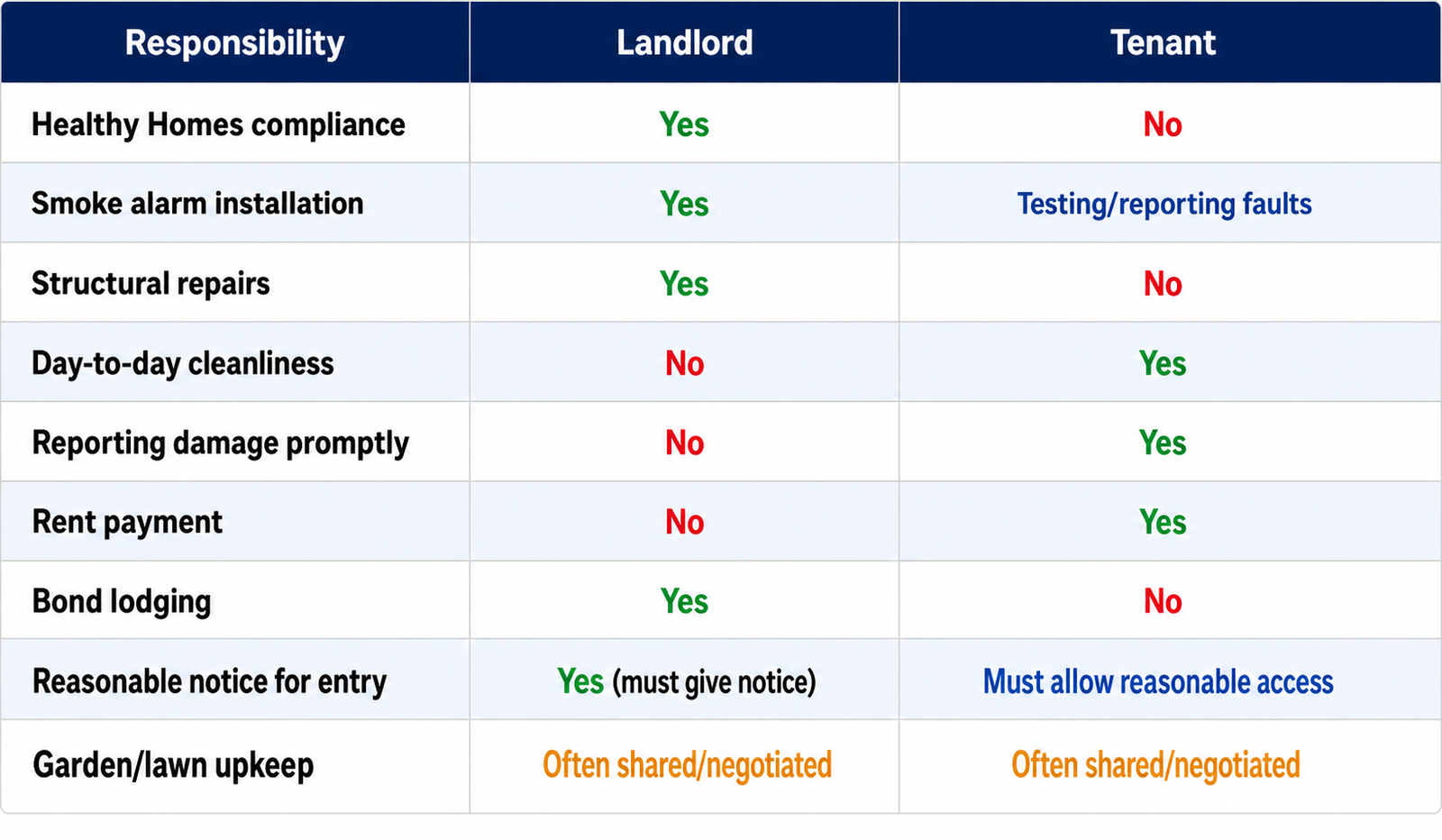
Landlord vs Tenant Responsibilities: Quick Comparison
Frequently Asked Questions
What are landlord responsibilities in NZ?
Landlords must maintain the property in a reasonable state of repair, meet Healthy Homes Standards, install smoke alarms, handle bonds correctly, respect tenant privacy, and comply with the Residential Tenancies Act 1986.
Can landlords enter without notice?
No. Landlords must give at least 48 hours’ written notice before entering, except in genuine emergencies where immediate access protects life or property.
Who pays for repairs?
Landlords cover repairs from normal wear and tear or property defects. Tenants cover damage they cause through negligence or intentional acts.
Are landlords responsible for noisy tenants?
Yes, when the noise breaches the tenancy agreement and complaints are genuine and persistent — though councils handle direct noise control enforcement.
What are Healthy Homes Standards?
Minimum legal requirements covering heating, insulation, ventilation, moisture and drainage, and draught stopping in every rental property in New Zealand.
What happens if a landlord breaks tenancy rules?
Breaches can trigger Tenancy Tribunal orders, exemplary damages, and in serious or repeated cases, restrictions on future property management activity.
What maintenance is legally required?
Landlords must keep the property in a reasonable state of repair, covering plumbing, electrical safety, structural integrity, and Healthy Homes compliance.
What are commercial landlord responsibilities in NZ?
These come largely from the lease agreement, but typically include structural maintenance, building compliance, and insurance, while tenants often manage interior fit-out.
Do landlords have to provide heating?
Yes. The Healthy Homes Standards require a fixed heater capable of adequately heating the main living room.
How often can inspections be carried out?
No fixed legal limit exists, but inspections must stay reasonable in frequency and always come with at least 48 hours’ written notice.
Final Thoughts
Understanding landlord responsibilities in NZ protects more than your compliance record — it protects your investment and your relationships with tenants. Healthy Homes compliance, bond handling, maintenance obligations, the occasional noisy tenant dispute: it adds up to a lot of work on top of everything else in your life.
That’s why so many landlords across New Zealand choose to work with The Rental Specialists. Our team handles compliance, maintenance, tenant management, and day-to-day communication, so you get the benefits of property investment without the administrative load or the risk of falling foul of constantly evolving rules.
Want to explore how professional, compliant property management could work for your rental? Take a look at our low-cost property management options in South Auckland, or get in touch through our homepage to discuss your property today.