Introduction
If you own a rental property in New Zealand, “Healthy Homes Standards” isn’t just industry jargon — it’s a legal obligation that shapes almost everything about how your property is heated, insulated, ventilated, and maintained. For landlords, understanding these standards properly is no longer optional. Since mid-2025 the standards apply universally, with no distinction between older and newer tenancies.
Getting it wrong isn’t a small mistake. Non-compliance can mean tenant disputes, Tenancy Tribunal penalties, and costly last-minute remedial work — often at the worst possible time, like mid-winter when a heating system fails an inspection.
This guide walks you through exactly what the Healthy Homes Standards require, breaks down all five standards in plain English, gives you a practical compliance checklist, and explains what happens if your property falls short — so you can get compliant and stay that way.
What Are the Healthy Homes Standards in NZ?
The Healthy Homes Standards are a set of minimum legal requirements for rental properties in New Zealand, designed to make rental homes warmer, drier, and healthier to live in. They sit under the Residential Tenancies (Healthy Homes Standards) Regulations 2019, and landlords must ensure a property meets the standards — unless a valid exemption applies — and continues to meet them over time.
They apply to virtually all private rental properties across the country, from single rental homes to large managed portfolios. The standards sit under the Residential Tenancies Act 1986, and the biggest update for landlords to understand is this: every private rental in New Zealand must now comply with all five standards at all times, regardless of when the tenancy started. The older framework, which gave landlords 90 or 120 days from the start of a new or renewed tenancy to reach compliance, has been fully phased out.
In short: if you’re currently renting out a property, it needs to meet the standards now — not by some future deadline.
What Are the 5 Healthy Homes Standards?
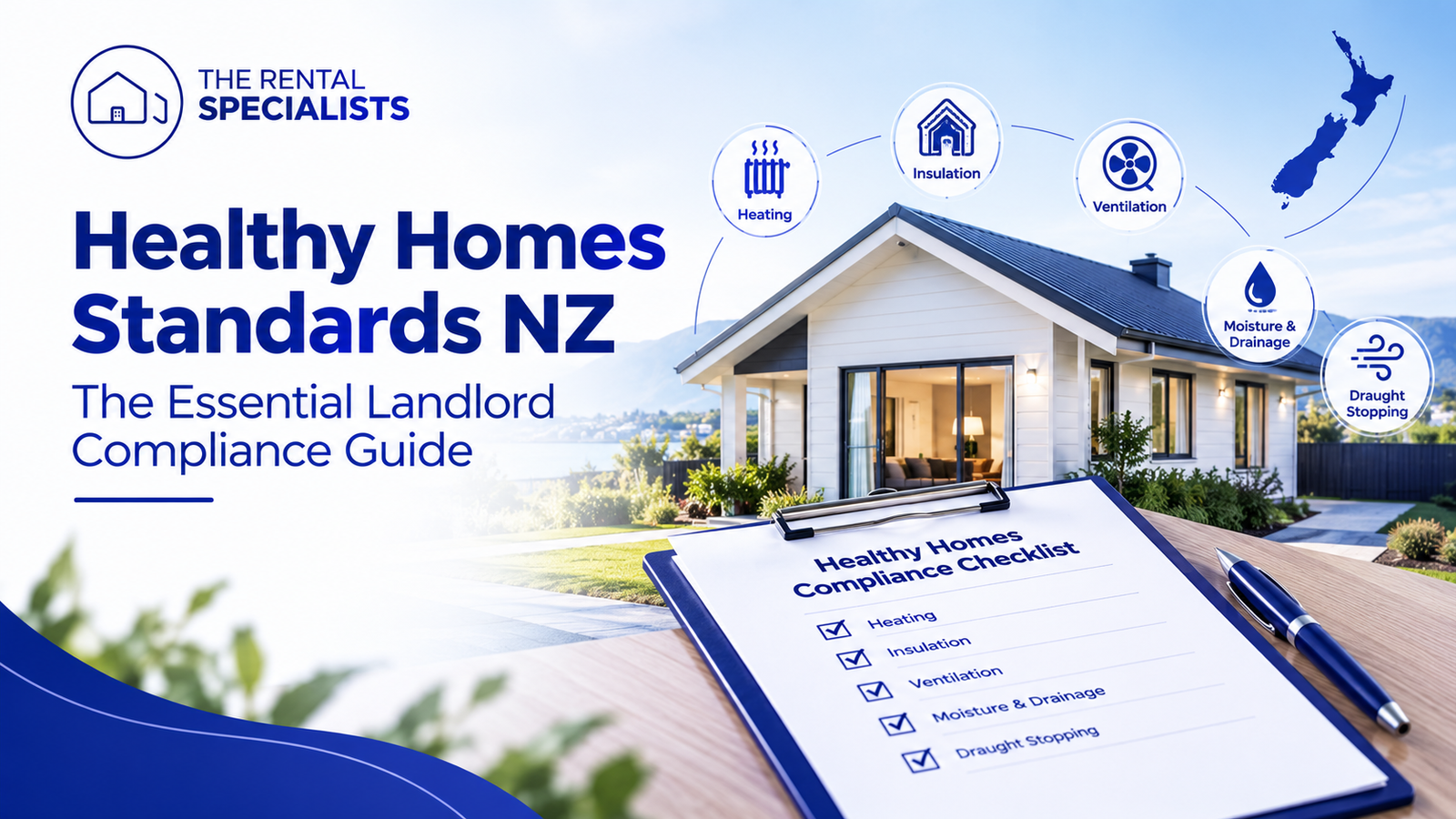
There are five standards landlords need to meet, covering heating, insulation, ventilation, moisture and drainage, and draught stopping. Here’s what each one actually requires.
1. Heating Standard
Every rental property needs a fixed heater in the main living room capable of adequately warming that space. The heater must be able to warm the main living room to at least 18°C, with each qualifying heater rated at a minimum of 1.5kW of heating capacity.
The exact capacity required isn’t one-size-fits-all — it depends on the specific room. The required heating capacity in kilowatts depends on the room size, ceiling height, window area, and climate zone, and MBIE provides an online calculator at tenancy.govt.nz to work out the minimum kW needed for any given room.
It’s also worth noting that the rules were refined to reflect better-built modern homes. The heating standard was amended in May 2022 to reflect that homes built or renovated to 2008 building code insulation and glazing requirements, along with some apartments, have higher thermal performance — meaning smaller heaters are generally sufficient in these homes.
Heat pumps, flued gas heaters, and other qualifying fixed heating sources can all be used to meet the standard, but portable, unflued options generally won’t count.
2. Insulation Standard
Insulation has been a mandatory requirement for longer than the other standards. Ceiling and underfloor insulation has been mandatory in all rental homes since 1 July 2019, and insulation must meet a minimum R-value depending on the property’s climate zone, while also being in reasonable condition.
The specific R-values landlords need to hit are:
- Ceiling insulation: R2.9 in climate zones 1 and 2, R3.3 in zone 3
- Underfloor insulation: R1.3 nationwide
Old insulation doesn’t automatically pass. Qualifying insulation must have been installed in accordance with NZS 4246:2016 and be in reasonable condition or better, with the regulations setting out factors for judging condition — including dampness, damage, degradation, displacement, and whether performance is compromised. That means insulation installed decades ago may need replacing even if it’s technically still in place.
3. Ventilation Standard
Good ventilation reduces moisture buildup and helps prevent mould and condensation. The standard requires:
- Openable windows or doors equal to at least 5% of the floor area in every habitable room
- Extractor fans in kitchens and bathrooms, ducted to the outside rather than simply venting into a roof cavity
The rules around what counts as compliant extraction have also evolved. The ventilation standard was updated in May 2022 to allow continuous mechanical ventilation systems that extract to the outside from kitchens and bathrooms, provided the system received building consent on or after 1 November 2019.
4. Moisture Ingress and Drainage
This standard is about keeping water out of the property and managing what’s underneath it. It covers gutters, downpipes, drainage, and ground moisture control. Rental properties must have efficient drainage for the removal of stormwater, surface water, and groundwater, and where there’s an enclosed subfloor, a ground moisture barrier is generally required.
Dampness caused by poor drainage isn’t just a compliance issue — it’s a health and property-damage issue too, contributing to mould, rot, and poor indoor air quality.
5. Draught Stopping
The final standard is about sealing up the gaps that let cold air in and warm air out. This includes:
- Blocking unnecessary gaps around doors and windows
- Closing off unused open fireplaces
- Sealing other unreasonable gaps or holes in the building envelope
It’s often the cheapest standard to fix, but it’s also one of the most commonly overlooked, since draughts aren’t always obvious until you’re specifically looking for them.
Healthy Homes Compliance Requirements for NZ Landlords
Meeting the five physical standards is only part of the picture. Landlords also carry ongoing responsibilities around documentation and disclosure.
Since 1 July 2025, every private rental in New Zealand must comply with all five standards at all times, regardless of when the tenancy started — there’s no grace period left to work with. Tenancy Services’ own guidance on this, updated regularly, is worth bookmarking as the primary reference point: Tenancy Services — Healthy Homes Standards.
Landlords are also required to include a Healthy Homes compliance statement in every tenancy agreement, and to keep evidence that supports the claims made in it — invoices, assessment reports, insulation certificates, and photos of completed work are all worth retaining. If a dispute ever reaches the Tenancy Tribunal, good documentation is often what separates landlords who can demonstrate compliance from those who can only assert it.
Healthy Homes Compliance Statement: What Landlords Need to Know
The compliance statement is a formal declaration, included in the tenancy agreement, that sets out the current state of the property against each of the five standards.
It should typically cover:
- Whether the property currently meets each of the five standards
- Details of the fixed heating source and its rated capacity
- The type and R-value of insulation installed
- Ventilation provisions in habitable rooms, kitchens, and bathrooms
- Any relevant exemptions being relied upon, and the reasons for them
This statement needs to be provided at the start of a new tenancy and kept accurate throughout. If circumstances change — for example, a heater is replaced or insulation is upgraded — the statement should be updated to reflect that. Accurate documentation matters because it’s the primary evidence landlords have if compliance is ever challenged.
Healthy Homes Standards Checklist for Landlords
Use this as a quick self-audit before (and during) every tenancy:
☐ Fixed heater in the main living room rated to reach 18°C
☐ Heater capacity calculated or professionally assessed for the room size
☐ Ceiling insulation meets minimum R-value for your climate zone
☐ Underfloor insulation meets R1.3 and is in reasonable condition
☐ Habitable rooms have openable windows/doors ≥ 5% of floor area
☐ Kitchen has a compliant extractor fan or rangehood ducted outside
☐ Bathroom has a compliant extractor fan ducted outside
☐ Gutters, downpipes, and drains are clear and functioning
☐ Ground moisture barrier installed where subfloor is enclosed and accessible
☐ Unnecessary gaps, holes, and unused fireplaces are sealed
☐ Compliance statement completed and included in the tenancy agreement
☐ Supporting records and documentation are filed and up to date
Common Healthy Homes Compliance Mistakes Landlords Make
Relying on Old Insulation
Insulation that was compliant a decade ago may no longer meet current R-value requirements, or may have degraded, sagged, or become damp — all of which can fail an inspection.
Installing the Wrong Heating System
A heater that’s too small for the room, or one that isn’t a qualifying fixed heat source, won’t meet the standard even if it technically keeps the room “warm enough” most of the time.
Ignoring Bathroom and Kitchen Ventilation
Extractor fans that vent into a roof cavity rather than outside don’t count — this is one of the most common issues property managers flag during inspections.
Overlooking Moisture Problems
Blocked gutters or poor subfloor drainage are easy to miss because they’re not always visible from inside the property, but they’re a direct compliance failure.
Forgetting Draughts
Landlords often focus on the “big” standards — heating and insulation — and overlook draught stopping entirely, even though it’s usually the fastest and cheapest fix.
Not Keeping Proper Documentation
Even a fully compliant property can run into disputes if there’s no paperwork to back it up. Invoices, certificates, and photos matter as much as the physical work itself.
How Much Does Healthy Homes Compliance Cost in NZ?
Costs vary significantly depending on the property’s age, condition, size, and climate zone, so it’s worth treating any figures as a general guide rather than a fixed quote. Broadly, costs are influenced by:
- Heating: the size and type of heater needed for the room, and whether existing wiring or ventilation for a heat pump needs upgrading
- Insulation: whether ceiling and underfloor insulation need to be installed from scratch or simply topped up, and how accessible the subfloor is
- Ventilation: whether extractor fans need to be newly installed and ducted outside, or existing ones simply need repair
- Moisture and drainage: the extent of any gutter, downpipe, or subfloor moisture barrier work required
- Draught stopping: generally the cheapest category, often involving sealant, weather-stripping, and minor repairs
Because every property is different, the most reliable way to budget is to get a professional Healthy Homes assessment and itemised quotes before starting work, rather than estimating costs based on a generic figure.
What Happens If a Landlord Doesn’t Meet Healthy Homes Standards?
Non-compliance carries real financial and legal risk. Landlords who don’t comply are at risk of a fine of up to $7,200 per breach, and the Tenancy Tribunal can award penalties up to that amount per breach, with additional penalties possible for missing compliance documentation.
Beyond the financial penalty, non-compliance can also lead to:
- Formal tenant complaints or Tenancy Tribunal applications
- Damaged relationships with good tenants who may choose not to renew
- Forced, urgent remedial work — often more expensive than planned work
- Reputational issues, particularly for landlords using a property management company
Waiting until a problem arises — a tenant complaint, an inspection, or a tenancy renewal — is a risky strategy. Since compliance is already mandatory for every private rental, the safest approach is to assess your property now rather than reactively.
How to Make Your Rental Property Healthy Homes Compliant
If you’re not confident your property is fully compliant, here’s a practical path forward:
- Assess the property against all five standards, ideally using a professional Healthy Homes assessment.
- Identify gaps between your property’s current condition and the legal minimums.
- Prioritise required work, starting with anything that’s a clear legal shortfall rather than a “nice to have.”
- Get qualified professionals involved where the work requires it — insulation installers, electricians, or heating specialists.
- Complete improvements, addressing all five standards rather than just the most obvious one.
- Keep invoices and records for every piece of work completed.
- Prepare or update your compliance statement to reflect the property’s current condition.
- Continue monitoring the property, since compliance isn’t a one-off task — insulation degrades, fans fail, and gutters block up over time.
Healthy Homes Standards vs General Property Maintenance
It’s worth being clear that Healthy Homes compliance and general property maintenance are related, but not the same thing.
Meeting the five Healthy Homes Standards satisfies a specific legal minimum. It doesn’t replace the landlord’s broader obligation to maintain the property in good repair throughout the tenancy — things like plumbing, appliances, structural integrity, and general wear and tear still need ongoing attention regardless of Healthy Homes status.
The most effective approach treats Healthy Homes compliance as one part of a wider rental property management strategy, rather than a separate, standalone task that’s addressed once and forgotten.
How The Rental Specialists Can Help Landlords
Staying on top of Healthy Homes compliance alongside everyday landlord responsibilities can be time-consuming, especially if you own more than one property. The Rental Specialists can help landlords manage the full picture, including:
- Property inspections to identify Healthy Homes gaps early
- Coordinating maintenance and compliance work with trusted contractors
- Managing Healthy Homes compliance statements and documentation
- Tenant management and communication
- Rental appraisals to help you understand your property’s market position
- Rent collection and financial reporting
- Ongoing property management, so compliance is monitored continuously rather than only at tenancy renewal
Explore more on our Property Management Auckland, Rental Property Management Auckland, Property Management Services, Rental Appraisal, and Landlord Resources pages.
Frequently Asked Questions
What are the Healthy Homes Standards NZ?
They’re a set of five minimum legal requirements for rental properties, covering heating, insulation, ventilation, moisture ingress and drainage, and draught stopping.
What are the 5 Healthy Homes Standards?
Heating, insulation, ventilation, moisture ingress and drainage, and draught stopping.
Is Healthy Homes compliance mandatory in NZ?
Yes. Since mid-2025, the standards apply universally to all private rentals, with no exceptions based on when the tenancy began.
What are the heating requirements for rental properties?
A fixed heater capable of warming the main living room to at least 18°C, with each qualifying heater rated at a minimum of 1.5kW.
What are the insulation requirements in NZ rentals?
Ceiling insulation of R2.9 in climate zones 1 and 2, and R3.3 in zone 3, plus underfloor insulation of R1.3 nationwide.
Do rental properties need extractor fans?
Yes — kitchens and bathrooms need extractor fans that are ducted to the outside of the building.
What happens if a rental property is not Healthy Homes compliant?
Landlords risk a fine of up to $7,200 per breach, along with possible tenant disputes and forced remedial work.
How much does Healthy Homes compliance cost?
Costs vary widely depending on the property’s condition and size. A professional assessment and itemised quotes are the most reliable way to budget accurately.
Who is responsible for Healthy Homes compliance?
The landlord is responsible for ensuring the property meets — and continues to meet — all five standards.
How can I check whether my rental property meets the standards?
Arrange a professional Healthy Homes assessment, or work through a detailed self-audit checklist against all five standards.
Conclusion
Healthy Homes compliance isn’t a one-time deadline anymore — it’s an ongoing landlord responsibility. The properties that stay compliant long-term are the ones where landlords address all five standards together, rather than focusing on just one and hoping the rest holds up.
Keep your documentation current, arrange regular inspections to catch problems before they become breaches, and consider professional property management if compliance is starting to feel like a full-time job on top of everything else. It’s far easier — and cheaper — to stay ahead of Healthy Homes requirements than to scramble to fix them after a tenant complaint or Tribunal application.