
Why Insulation Compliance Matters for NZ Landlords
Insulation is one of the first things tenants notice in a rental, and one of the first things landlords get wrong. The rental property insulation requirements NZ landlords must meet apply to every private rental: ceiling and underfloor insulation that meets the minimum R-value, is in reasonable condition and is recorded in the tenancy agreement. Landlords who don’t meet their healthy homes obligations are in breach of the Residential Tenancies Act and may face financial penalties of up to $7,200, according to Tenancy Services.
This guide explains what the rules say, how thick and how effective your insulation needs to be, which exemptions exist and how to check your own property. It’s based on current official guidance, so you can assess your rental with confidence If you’d rather hand compliance over, our property management team in Auckland can look after it for you.
What Are the Rental Property Insulation Requirements in NZ?
In short, every private rental needs ceiling and underfloor insulation that meets the required level and is in reasonable condition. A few properties qualify for an exemption, but only in specific circumstances. We’ll cover those further down.
Understanding the Healthy Homes Insulation Standard
The healthy homes insulation standard sets the insulation requirements NZ rental properties must meet: ceiling and underfloor insulation that meets the 2008 Building Code requirements and stays in reasonable condition. It sits within the wider Healthy Homes Standards, which also cover heating, ventilation, moisture and draught stopping. All rental homes had to comply with those standards by 1 July 2025.
The reasoning is simple. A well-insulated home holds heat better, usually costs less to heat, stays drier and is less prone to mould.
How the Insulation Standard Relates to Earlier Regulations
Ceiling and underfloor insulation became compulsory in all rental homes on 1 July 2019, where it was reasonably practicable to install. The healthy homes insulation standard builds on those earlier requirements and lifts the bar for existing insulation. Older, lower minimums only applied until the healthy homes compliance date.
Amendments to the Healthy Homes Standards also took effect on 25 September 2025. They resolved technical inconsistencies and overlaps with older regulations. So if you’re reading older guidance online, check it against the current Tenancy Services pages.
Which Rental Properties Must Meet the Standard?
All private rentals must comply with the healthy homes insulation standard. That means houses, units and apartments let under a residential tenancy. Specific exemptions apply to certain areas or situations, but being an older property or having a hard-to-reach ceiling doesn’t exempt you automatically.
Insulation is also one part of your wider landlord obligations in NZ. Our guide to landlord responsibilities in NZ shows how it fits with maintenance, inspections and tenancy paperwork.
Minimum Ceiling and Underfloor Insulation Requirements
The minimum R-value depends on where your property is and which part of the home you’re insulating. Ceiling insulation and underfloor insulation have separate minimums, so check each one on its own.
Ceiling Insulation Requirements by Climate Zone
Ceiling requirements vary by climate zone:
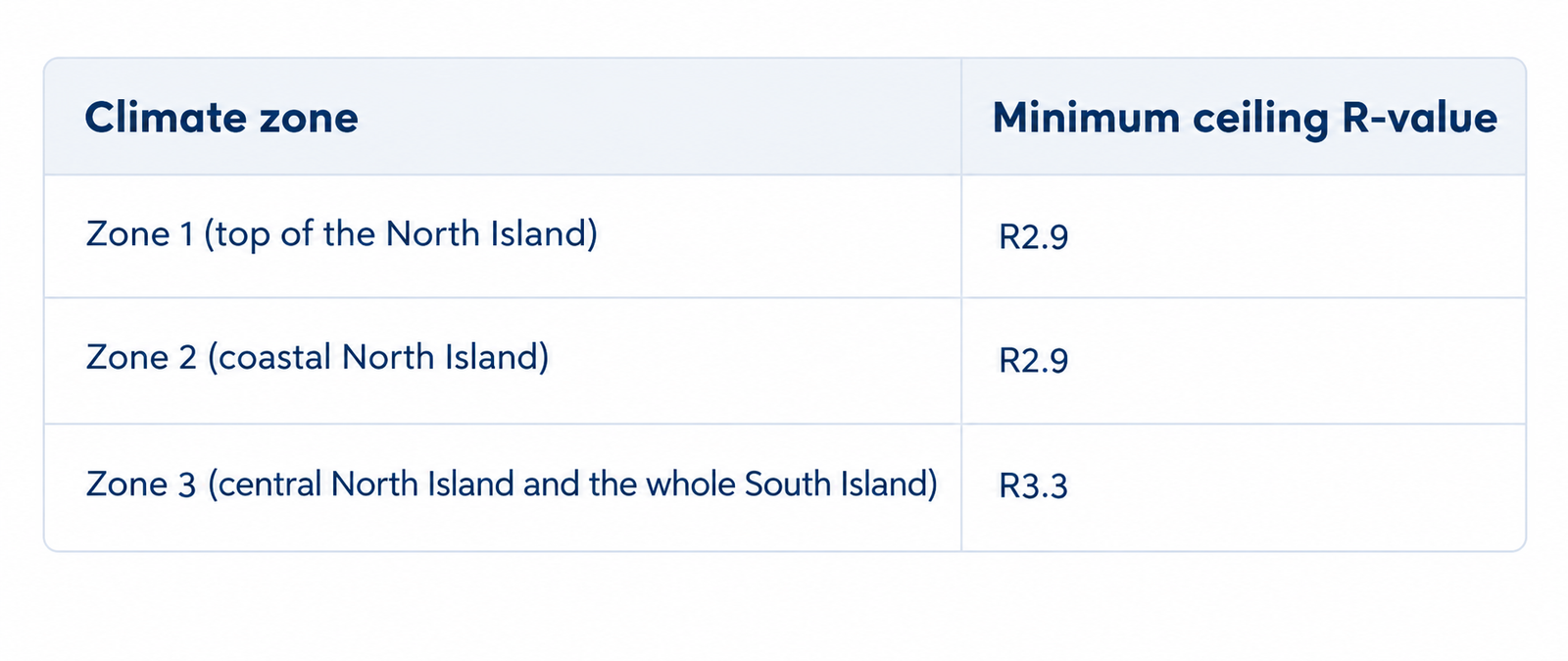
Auckland sits in the upper North Island, which falls in Zone 1, so R2.9 applies to most Auckland rentals. Zones 1 and 2 share the same minimums either way. Tenancy Services’ zone map applies to properties that received building consent before 3 November 2022, so check the map for your own property.
Underfloor Insulation Requirements for Rental Homes
The minimum underfloor R-value is R1.3 in all three zones. This applies to homes with a suspended floor, where there’s a space underneath to install insulation. Homes without that space, such as those built on a concrete slab, are treated differently under the exemptions below.
What Does an Insulation R-Value Mean?
R-value measures resistance to heat flow. The higher the number, the better the insulation performs. Thickness alone doesn’t tell you the R-value, because different materials perform differently at the same thickness. For new insulation, the R-value is on the product packaging.
Insulation Depth Requirements for Rental Properties in NZ
Depth matters, but it isn’t the whole story. The R-value is the main measure, and thickness comes into play mostly when you’re assessing older ceiling insulation. If you’re searching for depth of insulation requirements for rental property NZ landlords must meet, this section covers the one thickness rule that exists.
How Thick Must Existing Ceiling Insulation Be?
Existing ceiling insulation that was installed before 1 July 2016 must be at least 120 mm thick. That’s not a universal thickness requirement for all insulation. It applies to older existing ceiling insulation, and newly installed insulation needs to meet the minimum R-value instead.
There’s an exception. Ceiling insulation thinner than 120 mm is acceptable if you can prove two things:
- Its R-value met the minimum (2.9 or 3.3, depending on the zone) when it was installed.
- Its thickness hasn’t degraded by more than 30% compared with when it was installed.
Without that evidence, the 120 mm rule applies.
When Does Insulation Need to Be Topped Up or Replaced?
Insulation needs attention when it’s thinner than the rule allows and you can’t prove the exception, when its R-value falls below the minimum, or when its condition has slipped. Whether a top-up is enough or replacement is the better option depends on what’s already there. A professional installer can tell you which one suits your ceiling or underfloor.
How to Check Insulation Labels and Records
Start with the paperwork and the physical evidence:
- Product packaging, which sometimes ends up stapled to a beam in the ceiling or underfloor space
- Installer invoices and product details
- Code compliance certificates or other compliance documents
- Your own measurements of the insulation’s thickness
If the records are missing, the information in the council building file can also help. Keep copies of anything you find.
When Does Existing Rental Property Insulation Need an Upgrade?
Having insulation present isn’t the same as meeting the standard. It needs the right R-value, the right thickness where the 120 mm rule applies and reasonable condition.
Insulation That Falls Below the Required R-Value
If existing insulation doesn’t reach R2.9 or R3.3 for the ceiling, or R1.3 underfloor, it needs upgrading. This often affects older homes, where insulation went in under earlier, lower requirements. Check each area separately, because a home can pass in the ceiling and fail underneath.
Damaged, Damp, Mouldy or Gapped Insulation
Insulation condition matters as much as R-value. According to Tenancy Services, all existing insulation must be in reasonable condition, which means no mould, dampness, damage or gaps. Insulation that’s compressed, torn or missing in patches isn’t doing its job, even if the original R-value was fine. Fix the cause, such as a leak or poor drainage, before you replace the insulation, or the same problem will return.
Requirements for Newly Installed or Topped-Up Insulation
If you install or top up ceiling and underfloor insulation in an existing rental, it must meet the healthy homes insulation standard. You don’t need to meet the 2021 Building Code insulation requirements unless the property is undergoing renovations that need building consent.
New builds and consented renovations do need to meet the 2021 Building Code. A property that meets those requirements also meets the healthy homes insulation standard, because the 2021 requirements are higher. Either way, installation needs to follow NZS 4246:2016, which we cover below.
Exemptions from Rental Property Insulation Requirements
Tenancy Services lists three specific insulation exemptions: where access is impracticable or unsafe, partial exemptions, and areas with habitable spaces directly above or below. Insulation exemptions in NZ are narrow. They depend on the property’s actual circumstances and, often, on evidence you can show.
Properties Built on Concrete Slabs
A home built on a concrete slab has no suspended floor, so there’s no underfloor space to insulate. Tenancy Services gives this as an example of a situation where underfloor insulation can’t be installed. It only covers the floor. The ceiling still needs to meet the standard.
Apartments with Habitable Spaces Above and Below
Areas of ceilings or floors with another habitable space directly above or below don’t need insulation to meet the standard. That might be another floor of the same property or a neighbouring apartment. The exemption covers those areas only, so other parts of the apartment, such as a ceiling under the roof, may still need insulation.
Skillion Roofs and Limited Ceiling Space
Some homes have a skillion roof, where the roof slopes down from a high point and there’s no ceiling cavity. Tenancy Services gives one example of when installation isn’t reasonably practicable: the property has a skillion roof throughout and there isn’t enough space for a professional installer to reach the area. A partial exemption also exists for low-pitched roofs and limited ceiling cavities, which we cover below.
When Insulation Installation Is Unsafe or Impracticable
Some areas can be unsafe or not reasonably practicable to reach because of the design, limited access, potential for substantial damage or health and safety reasons. The exemption covers parts of a home where a professional installer can’t access or insulate the area, until that becomes possible. A re-roof is one example.
There’s an important limit. The exemption doesn’t apply if you simply need to create an access way. Tenancy Services notes that cutting an access hatch doesn’t count as major building work, so a hard-to-reach ceiling or underfloor isn’t an automatic exemption.
Partial Exemptions and Required Supporting Evidence
Two partial exemptions are available.
- Existing underfloor insulation: if the underfloor insulation was installed when the home was built or converted and is still in reasonable condition, you must hold compliance documents showing the home met the requirements of the time. A code compliance certificate or certificate of acceptance can do that.
- Compensating for ceiling insulation: where a low-pitched roof or limited ceiling cavity stops the ceiling meeting the standard, landlords must compensate with higher levels of floor, wall and window insulation that meet Building Code standards. This applies to properties consented after dates between October 2007 and September 2008, depending on the climate zone.
In both cases, evidence is what supports the exemption. Keep the documents, photos and professional assessments together.
Insulation Statements and Landlord Record-Keeping
Good records protect you. They also feed directly into the statement that goes in every new tenancy agreement.
What Must an Insulation Statement Include?
Every new tenancy agreement must include an insulation statement. You can include it in the healthy homes compliance statement or provide it separately. It must state:
- Whether there’s insulation in the rental home
- Where it is: walls, ceiling and underfloor
- What type of insulation it is
- What condition it’s in
You can attach a professional’s assessment too. It only counts as your insulation statement if it contains all the required information and you’ve signed it. Landlords could face a penalty of up to $500 for leaving out required information or including anything they know to be false or misleading.
Recording Insulation in Walls, Ceilings and Underfloor Areas
Wall insulation isn’t compulsory, but if your home has it, the statement still needs to cover it. Record each area separately: ceiling, underfloor and walls. Include the type and the condition you found, and keep dated photos and invoices on file to back it up.
What to Do When Insulation Information Is Missing
Sometimes you can’t find the details for a particular area, for example the walls. Tenancy Services says your statement must then do three things:
- Describe the information you can’t find
- Explain why you haven’t been able to find it
- Confirm that you’ve made all reasonable efforts to find it
Don’t guess to fill the gap. Old building files, installer invoices and a professional assessment are good places to start looking.
Insulation Installation and Safety Requirements
Good insulation that’s installed badly can cause problems. Safety needs just as much attention as R-values.
Following NZS 4246:2016
Insulation in rentals must be installed in accordance with New Zealand Standard 4246:2016, which covers installing bulk thermal insulation in residential buildings. You don’t need to memorise it. You do need an installer who works on it, so ask for confirmation in writing.
Electrical Clearances and Safe Installation
Insulation goes into spaces with wiring and fittings that give off heat, such as downlights. A competent installer keeps safe clearances around those fittings and avoids damaging cables. If you see old, damaged or exposed wiring in the ceiling or underfloor space, get an electrician to look at it before any insulation goes in.
What Landlords Should Know About Foil Insulation
Retrofitting or repairing foil underfloor insulation in existing residential buildings has been banned since 1 July 2016 under the Building Act, because metallic foil can become live if it contacts electrical wiring. So if existing foil is damaged and needs work, the replacement should be a non-foil product.
That doesn’t make every existing foil installation non-compliant. Tenancy Services includes foil insulation with the right compliance documents as one example of a partial exemption. But don’t inspect or repair foil yourself. Ask a qualified installer or electrician to assess it first.
How to Check Your Rental Property’s Insulation Compliance
You can do a lot of the checking yourself before calling anyone. Work through these steps in order.
Inspect Existing Insulation and Check Available Records
Look in the ceiling space and, where there’s access, underneath the house. Note the type of insulation, its thickness, its condition and any gaps, mould or damp patches. Then gather your records: packaging details, invoices, compliance documents and photos. Our rental property inspection checklist is a handy way to build insulation into your routine visits.
Use the Official Tenancy Services Insulation Tool
Tenancy Services has a free online insulation tool that tells you whether you need to upgrade the insulation in your rental. Work through it twice, once for the ceiling and once for the underfloor, because the answers can differ.
When to Seek Advice from a Professional Installer
Call a professional when:
- You can’t safely get into the ceiling or underfloor space
- You can’t confirm the R-value or thickness
- You find mould, dampness or damage
- You come across foil insulation or questionable wiring
- You think an exemption might apply and need an assessment to support it
If a repair or upgrade turns up other maintenance work, our guide to rental property maintenance in Auckland explains how that side is handled.
Keep Compliance Information Up to Date
Update your insulation statement whenever a new tenancy agreement is signed, and keep your evidence in one place. Insulation is just one of several healthy homes requirements. Our Healthy Homes Standards guide for landlords covers the rest, and our overview of smoke alarm requirements covers another compliance task worth checking at the same time.
Frequently Asked Questions
Q1. What are the minimum insulation requirements for rental properties in NZ?
Ceiling insulation needs a minimum R-value of R2.9 in Zones 1 and 2 and R3.3 in Zone 3. Underfloor insulation needs R1.3 in all zones. All insulation must also be in reasonable condition. Exemptions exist, but they’re specific.
Q2. How thick must ceiling insulation be in a rental property?
There’s no single thickness for every home. Existing ceiling insulation installed before 1 July 2016 must be at least 120 mm thick. Thinner insulation can be acceptable if you can prove it met the minimum R-value when installed and hasn’t degraded by more than 30%. Newly installed insulation is measured by R-value.
Q3. Does existing rental property insulation need to be replaced?
Not always. It depends on its R-value, thickness (where the 120 mm rule applies) and condition. Insulation that’s below the minimum, mouldy, damp, damaged or gapped needs to be topped up or replaced. A professional installer can advise.
Q4. Is wall insulation compulsory in NZ rental properties?
No. The healthy homes insulation standard covers ceilings and floors. However, if your home has wall insulation, your insulation statement must include it.
Q5. Can a rental property be exempt from insulation requirements?
Yes, but only in specific situations: access that’s impracticable or unsafe, certain partial exemptions, and areas with habitable spaces directly above or below. Evidence often supports the exemption, and creating an access hatch doesn’t count as a barrier.
Q6. How can landlords check whether their insulation complies?
Inspect the ceiling and underfloor spaces, collect your records and use the Tenancy Services insulation tool for each area. If anything is unclear, ask a professional installer for an assessment.
Get Support with Rental Property Compliance
Checking your insulation properly comes down to three things. Know the minimum R-values for your zone, understand when an exemption genuinely applies and keep accurate records for your tenancy statements. Insulation is only one piece of rental property compliance, but it’s one that tenants notice straight away.
If you’d rather not manage this alone, The Rental Specialists can help. We look after tenant screening, rent collection, maintenance coordination and compliance for landlords across Auckland and South Auckland. Have a look at our property management in Auckland service, contact The Rental Specialists or message us on WhatsApp to talk through your property.
This guide is general information, not legal advice. Check the current requirements on Tenancy Services before making compliance decisions.